


Last Updated:
August 27th, 2026
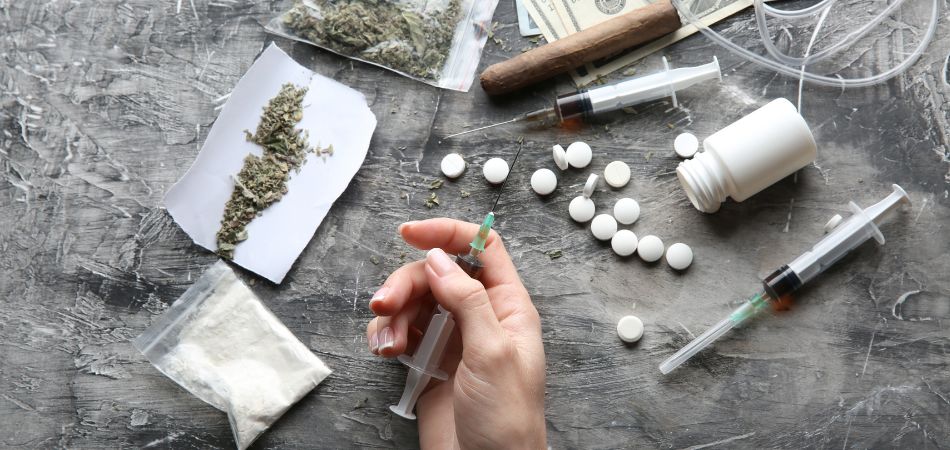
Many people who develop drug dependencies or an alcohol problem are using more than one substance. Sometimes that means taking two things together and sometimes it means using different drugs at different times. This is known as polysubstance use and it makes an addiction more difficult to treat and to recover from.
What polysubstance use means
Polysubstance use is the use of more than one drug and it takes a couple of different forms.
The first is using substances together in the same session, such as cocaine with alcohol or cannabis with alcohol.
The second is using different drugs for different purposes, for example a stimulant during the day and a depressant at night.
Prescription medication used alongside illicit drugs also counts and it is more common than many people assume. The two forms can overlap and a person may both combine substances in a single session and use different drugs across a week.
A large share of people who enter treatment in the UK report problems with more than one substance, so anyone in this position is far from alone.
Why do people mix substances?
Polysubstance use usually develops for reasons that make sense at the time and forming a relationship with both is never usually intended.
One reason is to increase the effect, using two substances to reach a stronger high than one would give. Another is to reduce the unwanted effects of a drug, such as taking something to ease a comedown.
Self-medication is another common reason, with substances used to manage anxiety or low mood, particularly where a mental health problem sits underneath the use.
Once dependence has developed, one drug may also be used to manage the withdrawal from another. This can hold two dependencies in place at the same time, with each one making the other harder to stop.
These patterns usually build gradually, one substance at a time, until a person is using several without having set out to. Because each addition can seem small at the point it is made, the change is easy to miss until the pattern is well established.
Why using more substances mean more risk
Using more than one substance raises the level of risk, because drugs interact in the body in ways that are harder to predict than a single drug used on its own.
More than half of all drug-poisoning deaths in England and Wales involve more than one drug. The effect of a combination depends on the substances involved and the person taking them, which is why the same mixture can affect two people differently.
Why treatment gets more complicated when more than one drug is involved
Treatment for one addiction is complicated enough on it’s own but when two or more substances are present, the whole situation becomes even more complex.
For example, initial assessment is harder because when several substances are involved, their effects overlap, making it more difficult to identify which symptom is caused by which substance. A symptom that looks like the effect of one drug may in fact come from another or from the combination.
Detox is also another aspect that becomes more complex, as coming off more than one substance can mean managing more than one withdrawal at the same time, each with its own timeline and its own risks.
This is one of the main reasons a detox overseen by medical professionals is very important when multiple drugs are involved. Withdrawal from one substance can also make withdrawal from another harder to manage, so the sequence and timing of a detox need to be planned rather than left to chance.
Treatment planning has to take account of every substance rather than the most obvious one, since a plan that addresses only part of the problem can leave the rest in place. Identifying every substance a person is using is an important early step and a full account at assessment makes the plan more accurate.
Relapse prevention is more involved as well, because there are more triggers to manage and a return to one substance can bring the others back with it. None of this makes recovery less likely but it does mean that the support needs to match the situation.
This makes a full, professional assessment a vital first step in addiction recovery.

The wider impact polydrug use can have
As we’ve shown, polysubstance use is a huge health risk but it also impacts other areas of a person’s life.
For example:
- Relationships can come under strain and work can suffer.
- The financial cost is usually higher when more than one substance is involved, since each carries its own expense and its own frequency of use.
- As more of a person’s time and money goes towards substances, other areas of life receive less.
The effects can build slowly enough that they are only clear once they have accumulated.
Another aspect is that the problems stemming from polydrug use can start to compound on each other, eventually reinforcing one another.
For example, a person might take a substance because they’re stressed and want to soften that feeling for a while. But once a dependency sets in, the stress is only amplified, coming now from both the original source and the pressure of using the drug regularly.
This is part of why treatment designed for more than one substance can be more effective than addressing each in isolation, since it accounts for how the different areas of a person’s use connect.
Where you can get help
If you recognise your own use here or you are concerned about someone using more than one substance, a good first step is to speak to someone who understands how these patterns work.
Your GP can help and local drug and alcohol services can be contacted directly. If you would prefer to talk through treatment that covers more than one substance, you can speak to us directly, with no pressure and no obligation.
How Sanctuary Lodge can help
If anything on this page applies to you or someone you care about, UKAT can help.
We provide treatment for drug and alcohol addiction across the UK, including support for people using more than one substance.
This includes detox where it is needed, along with therapy that addresses the full pattern of use rather than a single substance.
You do not need to have everything worked out before you get in touch. Contact Sanctuary Lodge today for a confidential conversation, with no pressure and no obligation.
(Click here to see works cited)
- Hirschtritt, M. E., Palzes, V. A., Kline-Simon, A. H., Kroenke, K., Campbell, C. I., & Sterling, S. A. (2019). Benzodiazepine and Unhealthy Alcohol Use Among Adult Outpatients. The American Journal of Managed Care, 25(12), e358. https://pmc.ncbi.nlm.nih.gov/articles/PMC7217068/
- ONS. (2025, October 16). Deaths related to drug poisoning in England and Wales. Ons.gov.uk; Office for National Statistics. https://www.ons.gov.uk/peoplepopulationandcommunity/birthsdeathsandmarriages/deaths/bulletins/deathsrelatedtodrugpoisoninginenglandandwales/2024registrations

